Victorian parents
Your child is below the national average in NAPLAN. Here's how to close the gap.
6 August 2026
The result that causes the most quiet worry
"Needs additional support" is unambiguous. You know where you stand and the school usually tells you.
The result that keeps parents up is the other one: your child sits just below the national average. Not flagged. Not failing. Just behind, quietly, across the board.
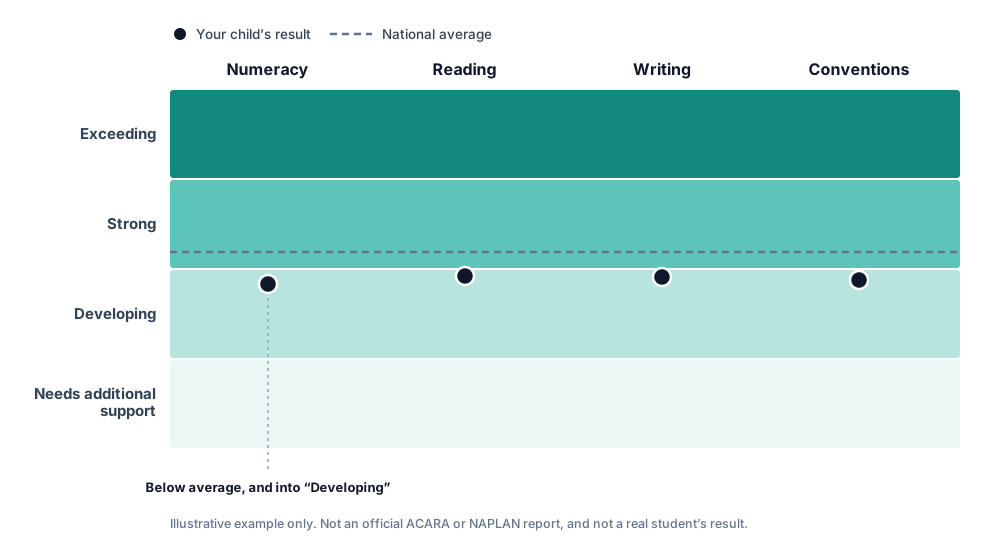
That picture is the one a lot of Victorian families opened in July. Nothing on it screams emergency, which is exactly why it is easy to file away and forget.
What "below average" actually does and does not mean
It does not mean your child is behind their peers in any dramatic sense. A very large share of perfectly capable students sit below the average, because that is how averages work. A single dot slightly below the line is not a verdict on their ability.
It does mean the gap is worth watching, particularly in numeracy. Maths is cumulative in a way other subjects are not. Year 5 fractions feed Year 7 ratios, which feed Year 9 algebra, which is what VCE Methods assumes is automatic. A small gap does not stay the same size. The curriculum keeps moving, so the gap widens by default unless something is done.
That is the honest version: not a crisis, but not nothing, and cheapest to fix now.
Build a free practice test
Pick a year level and topic. Fresh questions every time, with full worked solutions, ready to print.
Generate a free maths worksheet
Six questions across Foundation, Standard and Extension, with full worked solutions, calibrated to the Victorian Curriculum.
Textbook questions won't lift a test mark.
They come sorted by topic, so your child knows the method before they read the question.
That's where Tuterly comes in and closes the gap: unlimited questions, mixed up, under test conditions, including worded problems.
- ✓Unlimited questions on entire topics, mixed difficulty, VCAA aligned
- ✓Printable test, plus a separate answer key for marking
- ✓Any topic, any time, designed to mimic actual test questions
Free for 7 days, then $29/month. Cancel anytime.
Why this happens to students who are fine in class
The most common surprise is a child doing well in class maths who lands below average on NAPLAN. Usually it is not a maths problem at all. It is a format problem.
Class worksheets are sorted by topic. NAPLAN is not. A page headed "Fractions" tells your child the answer involves fractions. NAPLAN mixes topics with no warning, so the first job is working out what kind of problem you are even looking at. That step is rarely practised anywhere.
It leans on worded problems. Many questions are a short scenario, not a bare calculation. A student who computes perfectly can still lose marks translating the words into a sum.
It is timed. Slow and careful is a good habit right up until the clock runs out.
Fix those three and the dot moves, often without teaching a single new topic.
The plan that actually closes the gap
1. Find the specific skills, not the band. "Below average in numeracy" is not actionable. "Loses marks converting between fractions, decimals and percentages, and on multi-step worded problems" is. Read the sub-area breakdown on the report, and email the teacher: "Which two or three specific skills would you focus on if you were me?"
2. Diagnose where they are now. The report is months old. Sit them down with a practice test on the flagged topic and mark it together. That twenty minutes will tell you more than the report did, because it is current.
3. Sort every mistake into three buckets.
- Silly mistake (knew it, slipped): not a knowledge gap, do not re-teach.
- Method gap (did not know how to start), this is the real target.
- Ran out of time: needs practice at speed, not more explanation.
Most families re-teach an entire topic when the child had two slips and one genuine gap.
4. Practise the gaps, spaced out. Twenty minutes twice a week beats two hours on a Sunday. Spacing is what makes it stick.
5. Finish with mixed, timed practice. This is the step almost everyone skips. Once the gaps are closed, stop doing topic-by-topic sheets and start doing mixed practice tests under a clock, with worded problems. That is what the test actually asks for.
What this looks like over a year
NAPLAN is sat in March and results land in July, so you have roughly three terms. Term 3 diagnose, Term 4 close the gaps, summer keep it light, Term 1 switch to mixed test conditions. That is a comfortable pace, not a panic, and it is why starting when the report arrives beats cramming in February.
When to bring in help
Worth considering a tutor if the gap is in numeracy or reading and sits at Developing or below, if working on it at home is creating conflict rather than progress, or if your child has started saying they are "just bad at maths". That last one matters most: the belief does more long-term damage than the gap.
Related reading: how to read your child's NAPLAN results and how to improve NAPLAN results before the next test.
Want a full 25-question test?
Tuterly builds a complete practice test across a whole topic, mixed difficulty and VCAA aligned, with a separate answer key for marking. Any topic, any time, for every child on your account.
Build their first test free →Free for 7 days, then $29/month. Cancel anytime.