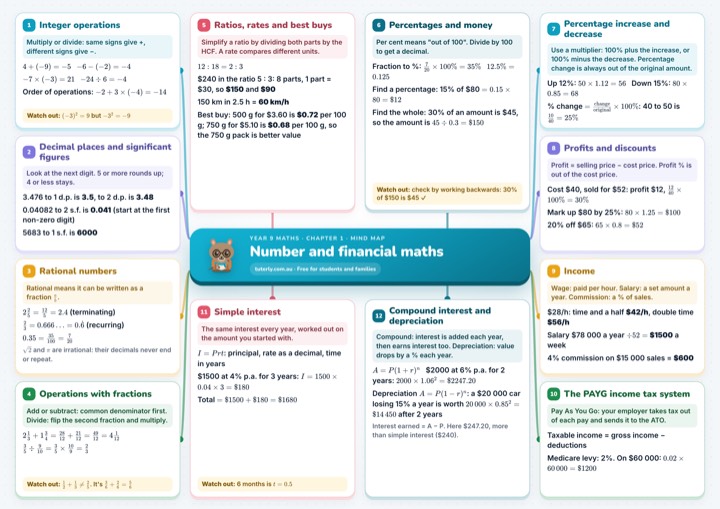
1Integer operations
Multiply or divide: same signs give +, different signs give −.
Order of operations:
Watch out: but
2Decimal places and significant figures
Look at the next digit. 5 or more rounds up; 4 or less stays.
3.476 to 1 d.p. is 3.5, to 2 d.p. is 3.48
0.04082 to 2 s.f. is 0.041 (start at the first non-zero digit)
5683 to 1 s.f. is 6000
3Rational numbers
Rational means it can be written as a fraction .
(terminating)
(recurring)
and are irrational: their decimals never end or repeat.
4Operations with fractions
Add or subtract: common denominator first. Divide: flip the second fraction and multiply.
Watch out: . It's
5Ratios, rates and best buys
Simplify a ratio by dividing both parts by the HCF. A rate compares different units.
$240 in the ratio 5 : 3: 8 parts, 1 part = $30, so $150 and $90
150 km in 2.5 h = 60 km/h
Best buy: 500 g for $3.60 is $0.72 per 100 g; 750 g for $5.10 is $0.68 per 100 g, so the 750 g pack is better value
6Percentages and money
Per cent means "out of 100". Divide by 100 to get a decimal.
Fraction to %:
Find a percentage: 15% of $80
Find the whole: 30% of an amount is $45, so the amount is
Watch out: check by working backwards: 30% of $150 is $45 ✓
7Percentage increase and decrease
Use a multiplier: 100% plus the increase, or 100% minus the decrease. Percentage change is always out of the original amount.
Up 12%: Down 15%:
% change : 40 to 50 is
8Profits and discounts
Profit = selling price − cost price. Profit % is out of the cost price.
Cost $40, sold for $52: profit $12,
Mark up $80 by 25%:
20% off $65:
9Income
Wage: paid per hour. Salary: a set amount a year. Commission: a % of sales.
$28/h: time and a half $42/h, double time $56/h
Salary $78 000 a year $1500 a week
4% commission on $15 000 sales = $600
10The PAYG income tax system
Pay As You Go: your employer takes tax out of each pay and sends it to the ATO.
Taxable income = gross income − deductions
Medicare levy: 2%. On $60 000:
11Simple interest
The same interest every year, worked out on the amount you started with.
: principal, rate as a decimal, time in years
$1500 at 4% p.a. for 3 years:
Total
Watch out: 6 months is
12Compound interest and depreciation
Compound: interest is added each year, then earns interest too. Depreciation: value drops by a % each year.
$2000 at 6% p.a. for 2 years:
Depreciation : a $20 000 car losing 15% a year is worth after 2 years
Interest earned = A − P. Here $247.20, more than simple interest ($240).

Year 9 maths · Chapter 1 · Mind map
Number and financial maths
tuterly.com.au · Free for students and families
See the full mind map
Free with your email, plus the A4 PDF to print.
In this chapter
- 1A Integer operations
- 1B Decimal places and significant figures
- 1C Rational numbers
- 1D Operations with fractions
- 1E Ratios, rates and best buys
- 1F Percentages and money
- 1G Percentage increase and decrease
- 1H Profits and discounts
- 1I Income
- 1J The PAYG income tax system
- 1K Simple interest
- 1L, 1M Compound interest and depreciation
Practise it
Free worksheets with worked solutions: