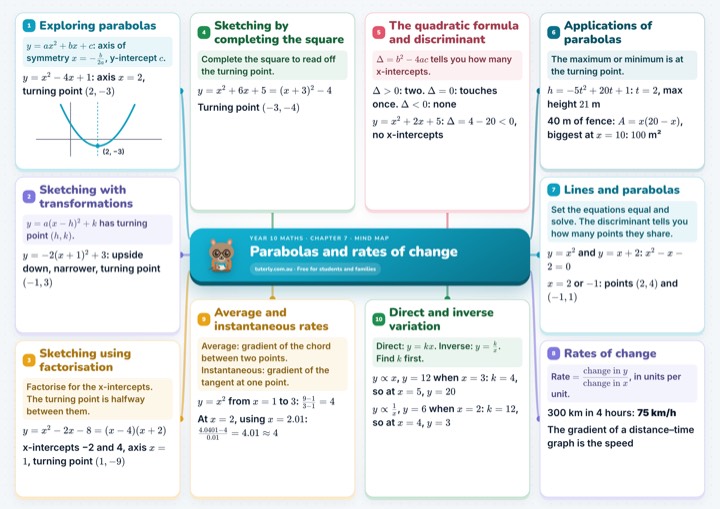
1Exploring parabolas
: axis of symmetry , y-intercept .
: axis , turning point
2Sketching with transformations
has turning point .
: upside down, narrower, turning point
3Sketching using factorisation
Factorise for the x-intercepts. The turning point is halfway between them.
x-intercepts −2 and 4, axis , turning point
4Sketching by completing the square
Complete the square to read off the turning point.
Turning point
5The quadratic formula and discriminant
tells you how many x-intercepts.
: two. : touches once. : none
: , no x-intercepts
6Applications of parabolas
The maximum or minimum is at the turning point.
: , max height m
40 m of fence: , biggest at : m²
7Lines and parabolas
Set the equations equal and solve. The discriminant tells you how many points they share.
and :
or : points and
8Rates of change
Rate , in units per unit.
300 km in 4 hours: 75 km/h
The gradient of a distance–time graph is the speed
9Average and instantaneous rates
Average: gradient of the chord between two points. Instantaneous: gradient of the tangent at one point.
from to :
At , using :
10Direct and inverse variation
Direct: . Inverse: . Find first.
, when : , so at ,
, when : , so at ,

Year 10 maths · Chapter 7 · Mind map
Parabolas and rates of change
tuterly.com.au · Free for students and families
See the full mind map
Free with your email, plus the A4 PDF to print.
In this chapter
- 7A Exploring parabolas
- 7B Sketching with transformations
- 7C Sketching using factorisation
- 7D Sketching by completing the square
- 7E The quadratic formula and discriminant
- 7F Applications of parabolas
- 7G Lines and parabolas
- 7H Rates of change
- 7I Average and instantaneous rates
- 7J Direct and inverse variation
Practise it
Free worksheets with worked solutions: