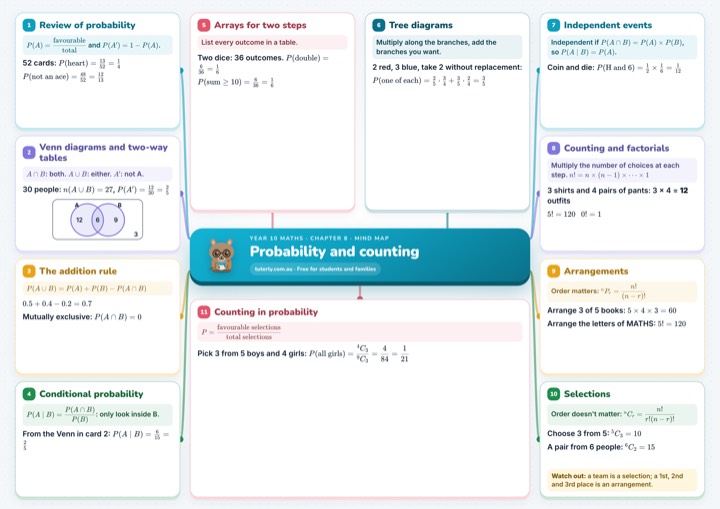
1 Review of probability P ( A ) = favourable total P(A) = \dfrac{\text{favourable}}{\text{total}} P ( A ) = total favourable P ( A ′ ) = 1 − P ( A ) P(A') = 1 - P(A) P ( A ′ ) = 1 − P ( A )
52 cards: P ( heart ) = 13 52 = 1 4 P(\text{heart}) = \tfrac{13}{52} = \tfrac14 P ( heart ) = 52 13 = 4 1
P ( not an ace ) = 48 52 = 12 13 P(\text{not an ace}) = \tfrac{48}{52} = \tfrac{12}{13} P ( not an ace ) = 52 48 = 13 12
2 Venn diagrams and two-way tables A ∩ B A \cap B A ∩ B A ∪ B A \cup B A ∪ B A ′ A' A ′
30 people: n ( A ∪ B ) = 27 n(A \cup B) = 27 n ( A ∪ B ) = 27 P ( A ′ ) = 12 30 = 2 5 P(A') = \tfrac{12}{30} = \tfrac25 P ( A ′ ) = 30 12 = 5 2
A B 12 6 9 3 3 The addition rule P ( A ∪ B ) = P ( A ) + P ( B ) − P ( A ∩ B ) P(A \cup B) = P(A) + P(B) - P(A \cap B) P ( A ∪ B ) = P ( A ) + P ( B ) − P ( A ∩ B )
0.5 + 0.4 − 0.2 = 0.7 0.5 + 0.4 - 0.2 = 0.7 0.5 + 0.4 − 0.2 = 0.7
Mutually exclusive: P ( A ∩ B ) = 0 P(A \cap B) = 0 P ( A ∩ B ) = 0
4 Conditional probability P ( A ∣ B ) = P ( A ∩ B ) P ( B ) P(A \mid B) = \dfrac{P(A \cap B)}{P(B)} P ( A ∣ B ) = P ( B ) P ( A ∩ B )
From the Venn in card 2: P ( A ∣ B ) = 6 15 = 2 5 P(A \mid B) = \tfrac{6}{15} = \tfrac25 P ( A ∣ B ) = 15 6 = 5 2
5 Arrays for two steps List every outcome in a table.
Two dice: 36 outcomes. P ( double ) = 6 36 = 1 6 P(\text{double}) = \tfrac{6}{36} = \tfrac16 P ( double ) = 36 6 = 6 1
P ( sum ≥ 10 ) = 6 36 = 1 6 P(\text{sum} \ge 10) = \tfrac{6}{36} = \tfrac16 P ( sum ≥ 10 ) = 36 6 = 6 1
6 Tree diagrams Multiply along the branches, add the branches you want.
2 red, 3 blue, take 2 without replacement:
P ( one of each ) = 2 5 ⋅ 3 4 + 3 5 ⋅ 2 4 = 3 5 P(\text{one of each}) = \tfrac25 \cdot \tfrac34 + \tfrac35 \cdot \tfrac24 = \tfrac35 P ( one of each ) = 5 2 ⋅ 4 3 + 5 3 ⋅ 4 2 = 5 3
7 Independent events Independent if P ( A ∩ B ) = P ( A ) × P ( B ) P(A \cap B) = P(A) \times P(B) P ( A ∩ B ) = P ( A ) × P ( B ) P ( A ∣ B ) = P ( A ) P(A \mid B) = P(A) P ( A ∣ B ) = P ( A )
Coin and die: P ( H and 6 ) = 1 2 × 1 6 = 1 12 P(\text{H and } 6) = \tfrac12 \times \tfrac16 = \tfrac{1}{12} P ( H and 6 ) = 2 1 × 6 1 = 12 1
8 Counting and factorials Multiply the number of choices at each step. n ! = n × ( n − 1 ) × ⋯ × 1 n! = n \times (n - 1) \times \cdots \times 1 n ! = n × ( n − 1 ) × ⋯ × 1
3 shirts and 4 pairs of pants: 3 × 4 = 12 outfits
5 ! = 120 5! = 120 5 ! = 120 0 ! = 1 0! = 1 0 ! = 1
9 Arrangements Order matters: n P r = n ! ( n − r ) ! {}^nP_r = \dfrac{n!}{(n - r)!} n P r = ( n − r )! n !
Arrange 3 of 5 books: 5 × 4 × 3 = 60 5 \times 4 \times 3 = 60 5 × 4 × 3 = 60
Arrange the letters of MATHS: 5 ! = 120 5! = 120 5 ! = 120
10 Selections Order doesn't matter: n C r = n ! r ! ( n − r ) ! {}^nC_r = \dfrac{n!}{r!(n - r)!} n C r = r ! ( n − r )! n !
Choose 3 from 5: 5 C 3 = 10 {}^5C_3 = 10 5 C 3 = 10
A pair from 6 people: 6 C 2 = 15 {}^6C_2 = 15 6 C 2 = 15
Watch out: a team is a selection; a 1st, 2nd and 3rd place is an arrangement.
11 Counting in probability P = favourable selections total selections P = \dfrac{\text{favourable selections}}{\text{total selections}} P = total selections favourable selections
Pick 3 from 5 boys and 4 girls: P ( all girls ) = 4 C 3 9 C 3 = 4 84 = 1 21 P(\text{all girls}) = \dfrac{{}^4C_3}{{}^9C_3} = \dfrac{4}{84} = \dfrac{1}{21} P ( all girls ) = 9 C 3 4 C 3 = 84 4 = 21 1
Year 10 maths · Chapter 8 · Mind map
Probability and counting
tuterly.com.au · Free for students and families