Year 9 maths · Chapter 8

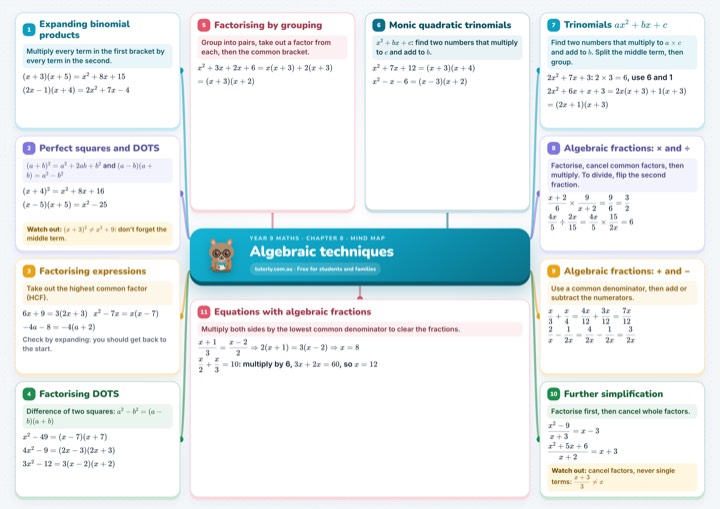
Year 9 Algebraic techniques: revision mind map

Expanding binomial products, perfect squares, difference of two squares, factorising (including trinomials), and algebraic fractions. Everything on one A4 page.

Download the free A4 PDF

Free with your email. Print it, stick it on the wall, or revise from it on your phone.

Free. Unlocks every mind map on this device. See our privacy policy.

1Expanding binomial products

Multiply every term in the first bracket by every term in the second.

(x+3)(x+5)=x2+8x+15(x + 3)(x + 5) = x^2 + 8x + 15

(2x−1)(x+4)=2x2+7x−4(2x - 1)(x + 4) = 2x^2 + 7x - 4

2Perfect squares and DOTS

(a+b)2=a2+2ab+b2(a + b)^2 = a^2 + 2ab + b^2 and (a−b)(a+b)=a2−b2(a - b)(a + b) = a^2 - b^2

(x+4)2=x2+8x+16(x + 4)^2 = x^2 + 8x + 16

(x−5)(x+5)=x2−25(x - 5)(x + 5) = x^2 - 25

Watch out: (x+3)2≠x2+9(x + 3)^2 \ne x^2 + 9: don't forget the middle term.

3Factorising expressions

Take out the highest common factor (HCF).

6x+9=3(2x+3)6x + 9 = 3(2x + 3)   x2−7x=x(x−7)x^2 - 7x = x(x - 7)

−4a−8=−4(a+2)-4a - 8 = -4(a + 2)

Check by expanding: you should get back to the start.

4Factorising DOTS

Difference of two squares: a2−b2=(a−b)(a+b)a^2 - b^2 = (a - b)(a + b)

x2−49=(x−7)(x+7)x^2 - 49 = (x - 7)(x + 7)

4x2−9=(2x−3)(2x+3)4x^2 - 9 = (2x - 3)(2x + 3)

3x2−12=3(x−2)(x+2)3x^2 - 12 = 3(x - 2)(x + 2)

5Factorising by grouping

Group into pairs, take out a factor from each, then the common bracket.

x2+3x+2x+6=x(x+3)+2(x+3)x^2 + 3x + 2x + 6 = x(x + 3) + 2(x + 3)

=(x+3)(x+2)= (x + 3)(x + 2)

6Monic quadratic trinomials

x2+bx+cx^2 + bx + c: find two numbers that multiply to cc and add to bb.

x2+7x+12=(x+3)(x+4)x^2 + 7x + 12 = (x + 3)(x + 4)

x2−x−6=(x−3)(x+2)x^2 - x - 6 = (x - 3)(x + 2)

7Trinomials ax2+bx+cax^2 + bx + c

Find two numbers that multiply to a×ca \times c and add to bb. Split the middle term, then group.

2x2+7x+32x^2 + 7x + 3: 2×3=62 \times 3 = 6, use 6 and 1

2x2+6x+x+3=2x(x+3)+1(x+3)2x^2 + 6x + x + 3 = 2x(x + 3) + 1(x + 3)

=(2x+1)(x+3)= (2x + 1)(x + 3)

8Algebraic fractions: × and ÷

Factorise, cancel common factors, then multiply. To divide, flip the second fraction.

x+26×9x+2=96=32\dfrac{x + 2}{6} \times \dfrac{9}{x + 2} = \dfrac{9}{6} = \dfrac32

4x5÷2x15=4x5×152x=6\dfrac{4x}{5} \div \dfrac{2x}{15} = \dfrac{4x}{5} \times \dfrac{15}{2x} = 6

9Algebraic fractions: + and −

Use a common denominator, then add or subtract the numerators.

x3+x4=4x12+3x12=7x12\dfrac{x}{3} + \dfrac{x}{4} = \dfrac{4x}{12} + \dfrac{3x}{12} = \dfrac{7x}{12}

2x−12x=42x−12x=32x\dfrac{2}{x} - \dfrac{1}{2x} = \dfrac{4}{2x} - \dfrac{1}{2x} = \dfrac{3}{2x}

10Further simplification

Factorise first, then cancel whole factors.

x2−9x+3=x−3\dfrac{x^2 - 9}{x + 3} = x - 3

x2+5x+6x+2=x+3\dfrac{x^2 + 5x + 6}{x + 2} = x + 3

Watch out: cancel factors, never single terms: x+33≠x\dfrac{x + 3}{3} \ne x

11Equations with algebraic fractions

Multiply both sides by the lowest common denominator to clear the fractions.

x+13=x−22⇒2(x+1)=3(x−2)⇒x=8\dfrac{x + 1}{3} = \dfrac{x - 2}{2} \Rightarrow 2(x + 1) = 3(x - 2) \Rightarrow x = 8

x2+x3=10\dfrac{x}{2} + \dfrac{x}{3} = 10: multiply by 6, 3x+2x=603x + 2x = 60, so x=12x = 12

Year 9 maths · Chapter 8 · Mind map

Algebraic techniques

tuterly.com.au · Free for students and families
See the full mind map

Free with your email, plus the A4 PDF to print.

In this chapter

  • 8A Expanding binomial products
  • 8B Perfect squares and DOTS
  • 8C Factorising expressions
  • 8D Factorising DOTS
  • 8E Factorising by grouping
  • 8F Monic quadratic trinomials
  • 8G Trinomials ax2+bx+cax^2 + bx + c
  • 8H Algebraic fractions: × and ÷
  • 8I Algebraic fractions: + and −
  • 8J Further simplification
  • 8K Equations with algebraic fractions

Practise it

Free worksheets with worked solutions: