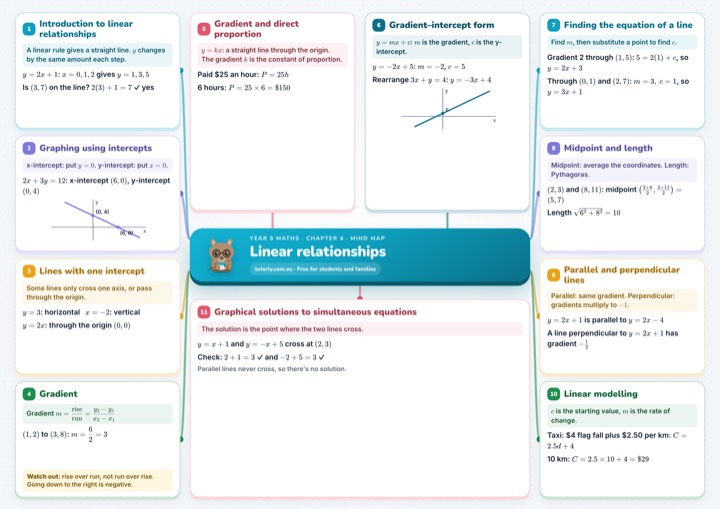
1Introduction to linear relationships
A linear rule gives a straight line. changes by the same amount each step.
: gives
Is on the line? ✓ yes
2Graphing using intercepts
x-intercept: put . y-intercept: put .
: x-intercept , y-intercept
3Lines with one intercept
Some lines only cross one axis, or pass through the origin.
: horizontal : vertical
: through the origin
4Gradient
Gradient
to :
Watch out: rise over run, not run over rise. Going down to the right is negative.
5Gradient and direct proportion
: a straight line through the origin. The gradient is the constant of proportion.
Paid $25 an hour:
6 hours:
6Gradient–intercept form
: is the gradient, is the y-intercept.
: ,
Rearrange :
7Finding the equation of a line
Find , then substitute a point to find .
Gradient 2 through : , so
Through and : , so
8Midpoint and length
Midpoint: average the coordinates. Length: Pythagoras.
and : midpoint
Length
9Parallel and perpendicular lines
Parallel: same gradient. Perpendicular: gradients multiply to .
is parallel to
A line perpendicular to has gradient
10Linear modelling
is the starting value, is the rate of change.
Taxi: $4 flag fall plus $2.50 per km:
10 km:
11Graphical solutions to simultaneous equations
The solution is the point where the two lines cross.
and cross at
Check: ✓ and ✓
Parallel lines never cross, so there's no solution.

Year 9 maths · Chapter 4 · Mind map
Linear relationships
tuterly.com.au · Free for students and families
See the full mind map
Free with your email, plus the A4 PDF to print.
In this chapter
- 4A Introduction to linear relationships
- 4B Graphing using intercepts
- 4C Lines with one intercept
- 4D Gradient
- 4E Gradient and direct proportion
- 4F Gradient–intercept form
- 4G Finding the equation of a line
- 4H Midpoint and length
- 4I Parallel and perpendicular lines
- 4J Linear modelling
- 4K Graphical solutions to simultaneous equations
Practise it
Free worksheets with worked solutions: