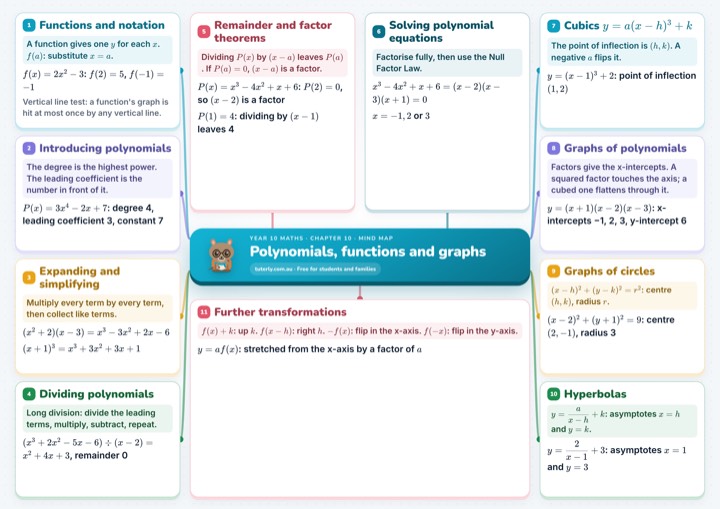
1Functions and notation
A function gives one for each . : substitute .
: ,
Vertical line test: a function's graph is hit at most once by any vertical line.
2Introducing polynomials
The degree is the highest power. The leading coefficient is the number in front of it.
: degree 4, leading coefficient 3, constant 7
3Expanding and simplifying
Multiply every term by every term, then collect like terms.
4Dividing polynomials
Long division: divide the leading terms, multiply, subtract, repeat.
, remainder 0
5Remainder and factor theorems
Dividing by leaves . If , is a factor.
: , so is a factor
: dividing by leaves 4
6Solving polynomial equations
Factorise fully, then use the Null Factor Law.
or
7Cubics
The point of inflection is . A negative flips it.
: point of inflection
8Graphs of polynomials
Factors give the x-intercepts. A squared factor touches the axis; a cubed one flattens through it.
: x-intercepts −1, 2, 3, y-intercept 6
9Graphs of circles
: centre , radius .
: centre , radius 3
10Hyperbolas
: asymptotes and .
: asymptotes and
11Further transformations
: up . : right . : flip in the x-axis. : flip in the y-axis.
: stretched from the x-axis by a factor of

Year 10 maths · Chapter 10 · Mind map
Polynomials, functions and graphs
tuterly.com.au · Free for students and families
See the full mind map
Free with your email, plus the A4 PDF to print.
In this chapter
- 10A Functions and notation
- 10B Introducing polynomials
- 10C Expanding and simplifying
- 10D Dividing polynomials
- 10E Remainder and factor theorems
- 10F Solving polynomial equations
- 10G Cubics
- 10H Graphs of polynomials
- 10I Graphs of circles
- 10J Hyperbolas
- 10K Further transformations
Practise it
Free worksheets with worked solutions: