Formula sheets · Year 7

Year 7 maths formula sheet

Every key formula and rule for Year 7 maths on one printable page, following the Australian Curriculum. Tap any formula to see worked examples on that topic.

Year 7 maths formula sheet

Australian Curriculum · tuterly.com.au/formula-sheets

Number

Order of operations
Brackets →\to Indices →×÷ (\to \times \div \ (left to right)→+− () \to + - \ (left to right))
Square and square root
52=255^2 = 2525=5\sqrt{25} = 5
Index notation
24=2×2×2×2=162^4 = 2 \times 2 \times 2 \times 2 = 16
Prime factor form
60=22×3×560 = 2^2 \times 3 \times 5
Percentage of an amount
p%p\% of A=p100×AA = \dfrac{p}{100} \times A
Fraction to percentage
partwhole×100%\dfrac{\text{part}}{\text{whole}} \times 100\%
Dividing fractions
ab÷cd=ab×dc\dfrac{a}{b} \div \dfrac{c}{d} = \dfrac{a}{b} \times \dfrac{d}{c}
Ratio
a:b=ka:kba : b = ka : kb((multiply or divide both parts by the same number))

Algebra

Distributive law
a(b+c)=ab+aca(b + c) = ab + ac
Substitution
If x=3, 2x+5=2(3)+5=11x = 3, \ 2x + 5 = 2(3) + 5 = 11
Solving an equation
Do the same to both sides: 2x+5=11⇒2x=6⇒x=32x + 5 = 11 \Rightarrow 2x = 6 \Rightarrow x = 3

Measurement

Perimeter of a rectangle
P=2(l+w)P = 2(l + w)
Area of a rectangle
A=lwA = lw
Area of a triangle
A=12bhA = \tfrac{1}{2}bh
Circumference of a circle
C=πd=2πrC = \pi d = 2\pi r
Length
11 cm =10= 10 mm, 1, \ 1 m =100= 100 cm, 1, \ 1 km =1000= 1000 m
Volume and capacity
11 cm3=1^3 = 1 mL, 1000, \ 1000 cm3=1^3 = 1 L

Space

Angles on a straight line
add to 180∘180^\circ
Angles around a point
add to 360∘360^\circ
Parallel lines
corresponding and alternate angles are equal; co-interior angles add to 180∘180^\circ
Angle sum
triangle 180∘,180^\circ, quadrilateral 360∘, n360^\circ, \ n-sided polygon (n−2)×180∘(n - 2) \times 180^\circ

Statistics and probability

Mean
mean =sum of the valuesnumber of values= \dfrac{\text{sum of the values}}{\text{number of values}}
Median, mode, range
median: middle value in order; mode: most common; range == highest −- lowest
Probability
P(P(event)=number of favourable outcomestotal number of equally likely outcomes) = \dfrac{\text{number of favourable outcomes}}{\text{total number of equally likely outcomes}}
Probability scale
0≤P≤10 \le P \le 1(0=(0 = impossible, 1=, \ 1 = certain))

Free from Tuterly · worked examples and practice for every topic at tuterly.com.au
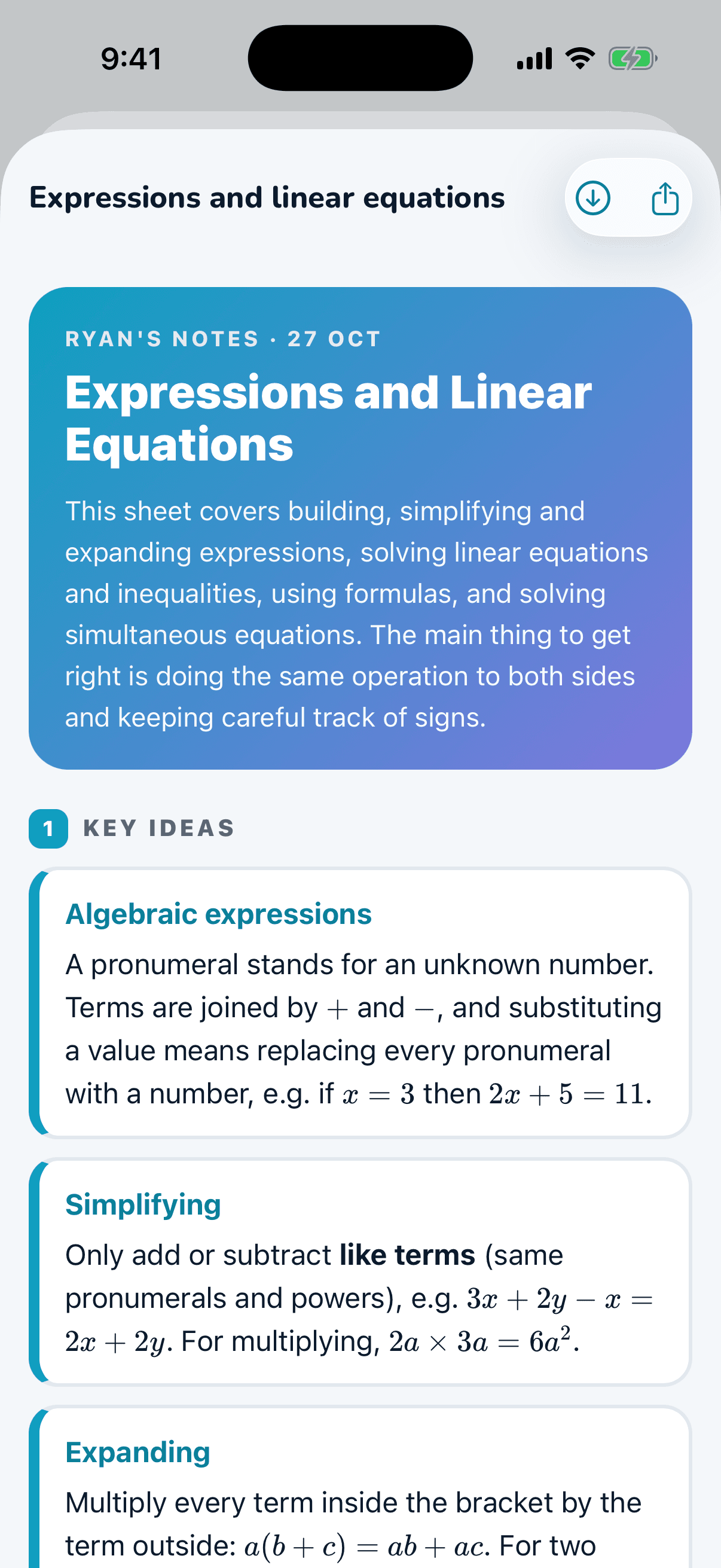
Study notes in the Tuterly app

Formulas are a start. Notes built around their mistakes are better.

  • Notes on any topic in their year, covering every part of it, with worked examples, ready in moments.
  • Or notes built from the questions they got wrong, with a “watch out” for each mistake they’ve made and how to fix it.
  • Download or share as a PDF, ready to revise from before a test.

Coming soon on iPhone. Android soon after.

We only use your email for Tuterly updates. See our privacy policy.

Free to download · 7-day free trial on monthly · Years 7 to 10 maths · On iPhone. Android coming soon

A Tuterly study notes sheet with a summary and key ideas

Other years: Year 8 · Year 9 · Year 10 · Year 10A