Set introduction to quadratic equations and graphs for your class
Auto-marked test, shared by link
Opens the Teacher Zone with every topic in this chapter ticked. Students are marked as soon as they finish, with worked solutions.
Create a testPrintable practice exam
A PDF with marks, a suggested time and answers, including questions that need working or an explanation.
Build an examWhat Year 9 Introduction to quadratic equations and graphs covers
8 topics, in textbook order.
- Quadratic equations
- Solving ax² + bx = 0 and x² = d
- Solving x² + bx + c = 0
- Using quadratic equations to solve problems
- The parabola
- Sketching y = ax² with dilations and reflections
- Sketching translations of y = x²
- Sketching parabolas using intercept form
Revision mind map
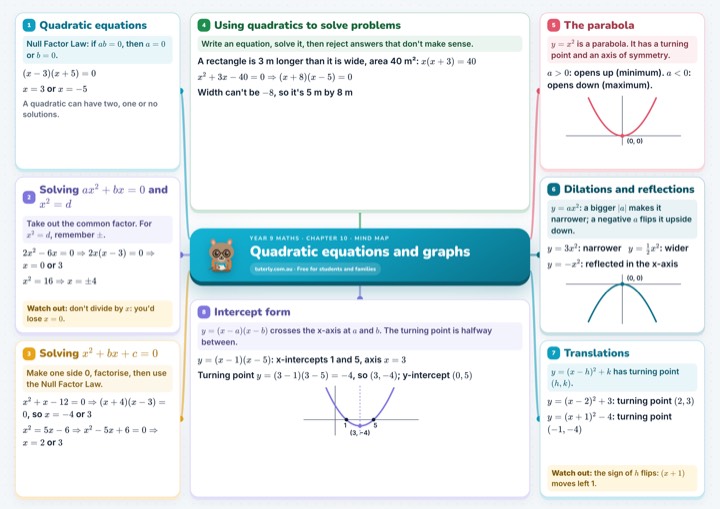
Year 9 Introduction to quadratic equations and graphs: the whole chapter on one page
Solving quadratic equations with the Null Factor Law, quadratic word problems, and sketching parabolas: dilations, reflections, translations and intercept form. A worked example for each topic, ready to print on A4 for revision or to put on the board.
View and download (PDF)Ideas for using them in class
Questions 1 to 4 of each topic test are the basics. Put one or two on the board to start the lesson.
Set a 5-question auto-marked test at the end of a lesson. Students see their mark straight away, and you see who needs another go when they tell you their score.
Print the practice sheet with the answers on the last page so students can self-mark, or share a Teacher Zone link and it marks itself.
The full 20-question test runs from the basics to harder problems. A week before the real test, it shows students where their gaps are.
The printable exam builder mixes topics with marks and a suggested time, for end-of-term and end-of-year revision.
The last section of each full test (questions 17 to 20) has multi-step and problem-solving questions for students who finish early.
Other Year 9 chapters
- Reviewing number and financial mathematics
- Expressions and linear equations
- Pythagoras' theorem and trigonometry
- Linear relationships
- Measurement
- Indices and surds
- Geometry
- Algebraic techniques
- Probability and statistics
Chapter and topic names follow Cambridge Essential Mathematics for the Victorian Curriculum. Questions are Tuterly’s own. Tuterly isn’t affiliated with Cambridge University Press.