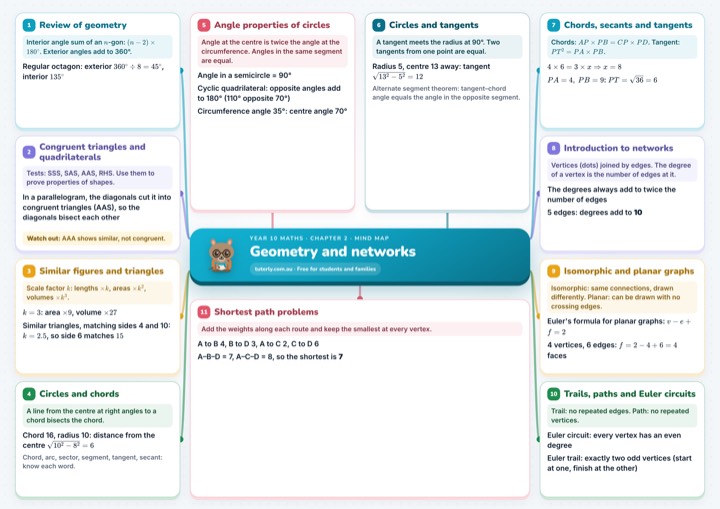
1Review of geometry
Interior angle sum of an -gon: . Exterior angles add to 360°.
Regular octagon: exterior , interior
2Congruent triangles and quadrilaterals
Tests: SSS, SAS, AAS, RHS. Use them to prove properties of shapes.
In a parallelogram, the diagonals cut it into congruent triangles (AAS), so the diagonals bisect each other
Watch out: AAA shows similar, not congruent.
3Similar figures and triangles
Scale factor : lengths , areas , volumes .
: area , volume
Similar triangles, matching sides 4 and 10: , so side 6 matches
4Circles and chords
A line from the centre at right angles to a chord bisects the chord.
Chord 16, radius 10: distance from the centre
Chord, arc, sector, segment, tangent, secant: know each word.
5Angle properties of circles
Angle at the centre is twice the angle at the circumference. Angles in the same segment are equal.
Angle in a semicircle = 90°
Cyclic quadrilateral: opposite angles add to 180° (110° opposite 70°)
Circumference angle 35°: centre angle 70°
6Circles and tangents
A tangent meets the radius at 90°. Two tangents from one point are equal.
Radius 5, centre 13 away: tangent
Alternate segment theorem: tangent–chord angle equals the angle in the opposite segment.
7Chords, secants and tangents
Chords: . Tangent: .
:
8Introduction to networks
Vertices (dots) joined by edges. The degree of a vertex is the number of edges at it.
The degrees always add to twice the number of edges
5 edges: degrees add to 10
9Isomorphic and planar graphs
Isomorphic: same connections, drawn differently. Planar: can be drawn with no crossing edges.
Euler's formula for planar graphs:
4 vertices, 6 edges: faces
10Trails, paths and Euler circuits
Trail: no repeated edges. Path: no repeated vertices.
Euler circuit: every vertex has an even degree
Euler trail: exactly two odd vertices (start at one, finish at the other)
11Shortest path problems
Add the weights along each route and keep the smallest at every vertex.
A to B 4, B to D 3, A to C 2, C to D 6
A–B–D = 7, A–C–D = 8, so the shortest is 7

Year 10 maths · Chapter 2 · Mind map
Geometry and networks
tuterly.com.au · Free for students and families
See the full mind map
Free with your email, plus the A4 PDF to print.
In this chapter
- 2A Review of geometry
- 2B, 2C Congruent triangles and quadrilaterals
- 2D, 2E Similar figures and triangles
- 2F Circles and chords
- 2G, 2H Angle properties of circles
- 2I Circles and tangents
- 2J Chords, secants and tangents
- 2K Introduction to networks
- 2L Isomorphic and planar graphs
- 2M Trails, paths and Euler circuits
- 2N Shortest path problems
Practise it
Free worksheets with worked solutions: