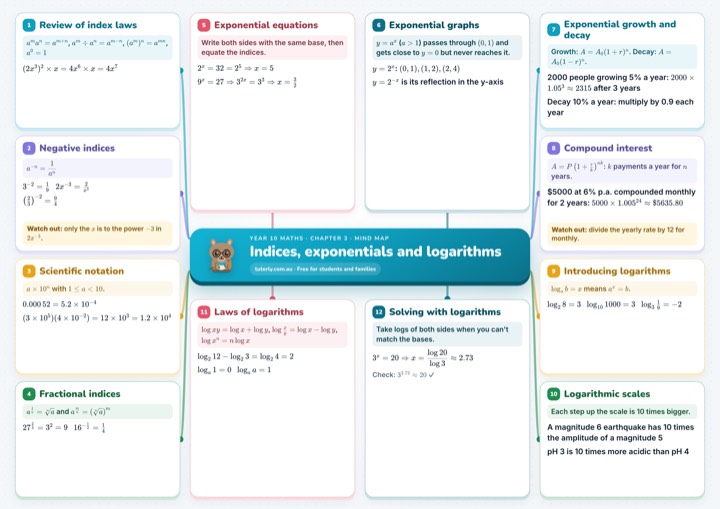
1 Review of index laws a m a n = a m + n a^m a^n = a^{m+n} a m a n = a m + n a m ÷ a n = a m − n a^m \div a^n = a^{m-n} a m ÷ a n = a m − n ( a m ) n = a m n (a^m)^n = a^{mn} ( a m ) n = a mn a 0 = 1 a^0 = 1 a 0 = 1
( 2 x 3 ) 2 × x = 4 x 6 × x = 4 x 7 (2x^3)^2 \times x = 4x^6 \times x = 4x^7 ( 2 x 3 ) 2 × x = 4 x 6 × x = 4 x 7
2 Negative indices a − n = 1 a n a^{-n} = \dfrac{1}{a^n} a − n = a n 1
3 − 2 = 1 9 3^{-2} = \tfrac19 3 − 2 = 9 1 2 x − 3 = 2 x 3 2x^{-3} = \tfrac{2}{x^3} 2 x − 3 = x 3 2
( 2 3 ) − 2 = 9 4 \left(\tfrac23\right)^{-2} = \tfrac94 ( 3 2 ) − 2 = 4 9
Watch out: only the x x x − 3 -3 − 3 2 x − 3 2x^{-3} 2 x − 3
3 Scientific notation a × 10 n a \times 10^n a × 1 0 n 1 ≤ a < 10 1 \le a < 10 1 ≤ a < 10
0.000 52 = 5.2 × 10 − 4 0.000\,52 = 5.2 \times 10^{-4} 0.000 52 = 5.2 × 1 0 − 4
( 3 × 10 5 ) ( 4 × 10 − 2 ) = 12 × 10 3 = 1.2 × 10 4 (3 \times 10^5)(4 \times 10^{-2}) = 12 \times 10^3 = 1.2 \times 10^4 ( 3 × 1 0 5 ) ( 4 × 1 0 − 2 ) = 12 × 1 0 3 = 1.2 × 1 0 4
4 Fractional indices a 1 n = a n a^{\frac1n} = \sqrt[n]{a} a n 1 = n a a m n = ( a n ) m a^{\frac mn} = \left(\sqrt[n]{a}\right)^m a n m = ( n a ) m
27 2 3 = 3 2 = 9 27^{\frac23} = 3^2 = 9 2 7 3 2 = 3 2 = 9 16 − 1 2 = 1 4 16^{-\frac12} = \tfrac14 1 6 − 2 1 = 4 1
5 Exponential equations Write both sides with the same base, then equate the indices.
2 x = 32 = 2 5 ⇒ x = 5 2^x = 32 = 2^5 \Rightarrow x = 5 2 x = 32 = 2 5 ⇒ x = 5
9 x = 27 ⇒ 3 2 x = 3 3 ⇒ x = 3 2 9^x = 27 \Rightarrow 3^{2x} = 3^3 \Rightarrow x = \tfrac32 9 x = 27 ⇒ 3 2 x = 3 3 ⇒ x = 2 3
6 Exponential graphs y = a x y = a^x y = a x a > 1 a > 1 a > 1 ( 0 , 1 ) (0, 1) ( 0 , 1 ) y = 0 y = 0 y = 0
y = 2 x y = 2^x y = 2 x ( 0 , 1 ) , ( 1 , 2 ) , ( 2 , 4 ) (0, 1), (1, 2), (2, 4) ( 0 , 1 ) , ( 1 , 2 ) , ( 2 , 4 )
y = 2 − x y = 2^{-x} y = 2 − x
7 Exponential growth and decay Growth: A = A 0 ( 1 + r ) n A = A_0(1 + r)^n A = A 0 ( 1 + r ) n A = A 0 ( 1 − r ) n A = A_0(1 - r)^n A = A 0 ( 1 − r ) n
2000 people growing 5% a year: 2000 × 1.05 3 ≈ 2315 2000 \times 1.05^3 \approx 2315 2000 × 1.0 5 3 ≈ 2315
Decay 10% a year: multiply by 0.9 each year
8 Compound interest A = P ( 1 + r k ) n k A = P\left(1 + \tfrac{r}{k}\right)^{nk} A = P ( 1 + k r ) nk k k k n n n
$5000 at 6% p.a. compounded monthly for 2 years: 5000 × 1.005 24 ≈ $ 5635.80 5000 \times 1.005^{24} \approx \$5635.80 5000 × 1.00 5 24 ≈ $5635.80
Watch out: divide the yearly rate by 12 for monthly.
9 Introducing logarithms log a b = x \log_a b = x log a b = x a x = b a^x = b a x = b
log 2 8 = 3 \log_2 8 = 3 log 2 8 = 3 log 10 1000 = 3 \log_{10} 1000 = 3 log 10 1000 = 3 log 3 1 9 = − 2 \log_3 \tfrac19 = -2 log 3 9 1 = − 2
10 Logarithmic scales Each step up the scale is 10 times bigger.
A magnitude 6 earthquake has 10 times the amplitude of a magnitude 5
pH 3 is 10 times more acidic than pH 4
11 Laws of logarithms log x y = log x + log y \log xy = \log x + \log y log x y = log x + log y log x y = log x − log y \log \tfrac xy = \log x - \log y log y x = log x − log y log x n = n log x \log x^n = n \log x log x n = n log x
log 2 12 − log 2 3 = log 2 4 = 2 \log_2 12 - \log_2 3 = \log_2 4 = 2 log 2 12 − log 2 3 = log 2 4 = 2
log a 1 = 0 \log_a 1 = 0 log a 1 = 0 log a a = 1 \log_a a = 1 log a a = 1
12 Solving with logarithms Take logs of both sides when you can't match the bases.
3 x = 20 ⇒ x = log 20 log 3 ≈ 2.73 3^x = 20 \Rightarrow x = \dfrac{\log 20}{\log 3} \approx 2.73 3 x = 20 ⇒ x = log 3 log 20 ≈ 2.73
Check: 3 2.73 ≈ 20 3^{2.73} \approx 20 3 2.73 ≈ 20
Year 10 maths · Chapter 3 · Mind map
Indices, exponentials and logarithms
tuterly.com.au · Free for students and families