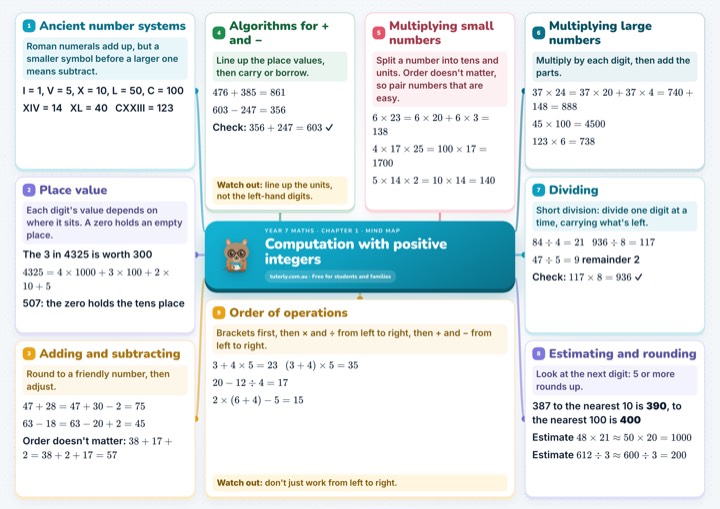
1Ancient number systems
Roman numerals add up, but a smaller symbol before a larger one means subtract.
I = 1, V = 5, X = 10, L = 50, C = 100
XIV = 14 XL = 40 CXXIII = 123
2Place value
Each digit's value depends on where it sits. A zero holds an empty place.
The 3 in 4325 is worth 300
507: the zero holds the tens place
3Adding and subtracting
Round to a friendly number, then adjust.
Order doesn't matter:
4Algorithms for + and −
Line up the place values, then carry or borrow.
Check: ✓
Watch out: line up the units, not the left-hand digits.
5Multiplying small numbers
Split a number into tens and units. Order doesn't matter, so pair numbers that are easy.
6Multiplying large numbers
Multiply by each digit, then add the parts.
7Dividing
Short division: divide one digit at a time, carrying what's left.
remainder 2
Check: ✓
8Estimating and rounding
Look at the next digit: 5 or more rounds up.
387 to the nearest 10 is 390, to the nearest 100 is 400
Estimate
Estimate
9Order of operations
Brackets first, then × and ÷ from left to right, then + and − from left to right.
Watch out: don't just work from left to right.

Year 7 maths · Chapter 1 · Mind map
Computation with positive integers
tuterly.com.au · Free for students and families
See the full mind map
Free with your email, plus the A4 PDF to print.
In this chapter
- 1A Ancient number systems
- 1B Place value
- 1C Adding and subtracting
- 1D Algorithms for + and −
- 1E Multiplying small numbers
- 1F Multiplying large numbers
- 1G Dividing
- 1H Estimating and rounding
- 1I Order of operations
Practise it
Free worksheets with worked solutions: