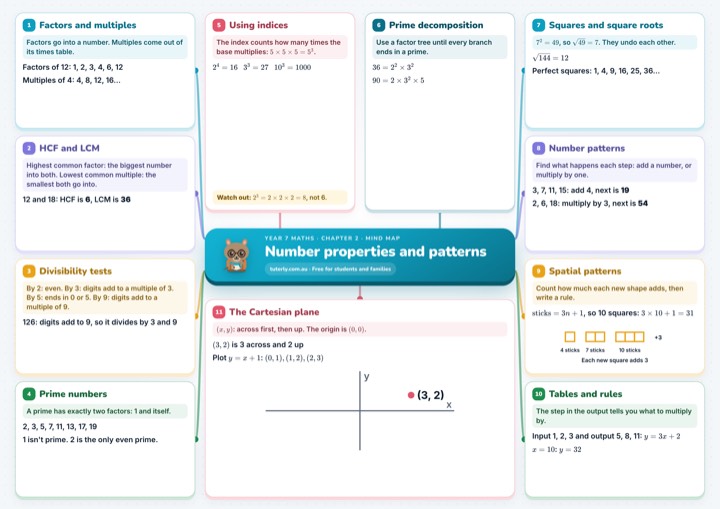
1Factors and multiples
Factors go into a number. Multiples come out of its times table.
Factors of 12: 1, 2, 3, 4, 6, 12
Multiples of 4: 4, 8, 12, 16…
2HCF and LCM
Highest common factor: the biggest number into both. Lowest common multiple: the smallest both go into.
12 and 18: HCF is 6, LCM is 36
3Divisibility tests
By 2: even. By 3: digits add to a multiple of 3. By 5: ends in 0 or 5. By 9: digits add to a multiple of 9.
126: digits add to 9, so it divides by 3 and 9
4Prime numbers
A prime has exactly two factors: 1 and itself.
2, 3, 5, 7, 11, 13, 17, 19
1 isn't prime. 2 is the only even prime.
5Using indices
The index counts how many times the base multiplies: .
Watch out: , not 6.
6Prime decomposition
Use a factor tree until every branch ends in a prime.
7Squares and square roots
, so . They undo each other.
Perfect squares: 1, 4, 9, 16, 25, 36…
8Number patterns
Find what happens each step: add a number, or multiply by one.
3, 7, 11, 15: add 4, next is 19
2, 6, 18: multiply by 3, next is 54
9Spatial patterns
Count how much each new shape adds, then write a rule.
, so 10 squares:
10Tables and rules
The step in the output tells you what to multiply by.
Input 1, 2, 3 and output 5, 8, 11:
:
11The Cartesian plane
: across first, then up. The origin is .
is 3 across and 2 up
Plot :

Year 7 maths · Chapter 2 · Mind map
Number properties and patterns
tuterly.com.au · Free for students and families
See the full mind map
Free with your email, plus the A4 PDF to print.
In this chapter
- 2A Factors and multiples
- 2B HCF and LCM
- 2C Divisibility tests
- 2D Prime numbers
- 2E Using indices
- 2F Prime decomposition
- 2G Squares and square roots
- 2H Number patterns
- 2I Spatial patterns
- 2J Tables and rules
- 2K The Cartesian plane
Practise it
Free worksheets with worked solutions: