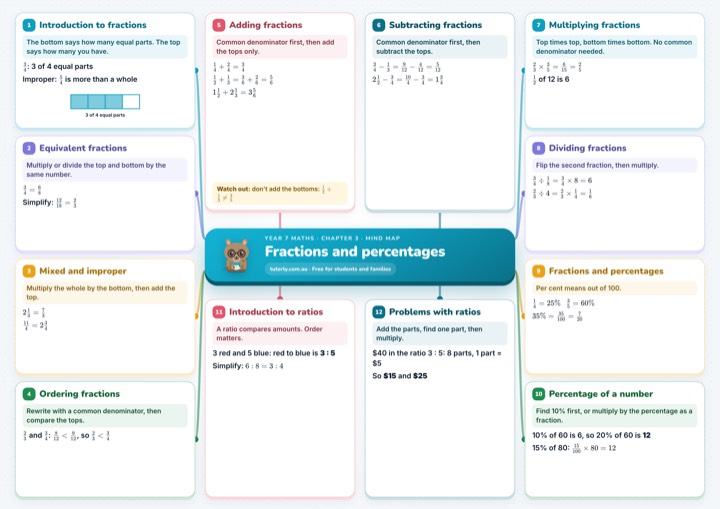
1Introduction to fractions
The bottom says how many equal parts. The top says how many you have.
: 3 of 4 equal parts
Improper: is more than a whole
2Equivalent fractions
Multiply or divide the top and bottom by the same number.
Simplify:
3Mixed and improper
Multiply the whole by the bottom, then add the top.
4Ordering fractions
Rewrite with a common denominator, then compare the tops.
and : , so
5Adding fractions
Common denominator first, then add the tops only.
Watch out: don't add the bottoms:
6Subtracting fractions
Common denominator first, then subtract the tops.
7Multiplying fractions
Top times top, bottom times bottom. No common denominator needed.
of 12 is 6
8Dividing fractions
Flip the second fraction, then multiply.
9Fractions and percentages
Per cent means out of 100.
10Percentage of a number
Find 10% first, or multiply by the percentage as a fraction.
10% of 60 is 6, so 20% of 60 is 12
15% of 80:
11Introduction to ratios
A ratio compares amounts. Order matters.
3 red and 5 blue: red to blue is 3 : 5
Simplify:
12Problems with ratios
Add the parts, find one part, then multiply.
$40 in the ratio 3 : 5: 8 parts, 1 part = $5
So $15 and $25

Year 7 maths · Chapter 3 · Mind map
Fractions and percentages
tuterly.com.au · Free for students and families
See the full mind map
Free with your email, plus the A4 PDF to print.
In this chapter
- 3A Introduction to fractions
- 3B Equivalent fractions
- 3C Mixed and improper
- 3D Ordering fractions
- 3E Adding fractions
- 3F Subtracting fractions
- 3G Multiplying fractions
- 3H Dividing fractions
- 3I Fractions and percentages
- 3J Percentage of a number
- 3K Introduction to ratios
- 3L Problems with ratios
Practise it
Free worksheets with worked solutions: