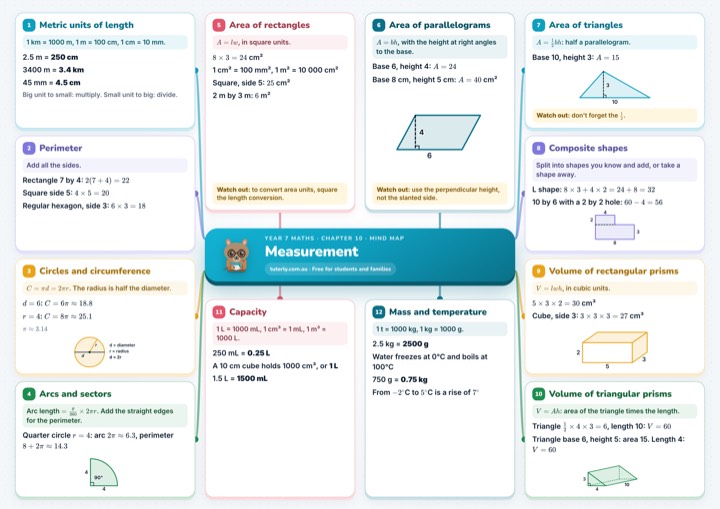
1Metric units of length
1 km = 1000 m, 1 m = 100 cm, 1 cm = 10 mm.
2.5 m = 250 cm
3400 m = 3.4 km
45 mm = 4.5 cm
Big unit to small: multiply. Small unit to big: divide.
2Perimeter
Add all the sides.
Rectangle 7 by 4:
Square side 5:
Regular hexagon, side 3:
3Circles and circumference
. The radius is half the diameter.
:
:
4Arcs and sectors
Arc length . Add the straight edges for the perimeter.
Quarter circle : arc , perimeter
5Area of rectangles
, in square units.
cm²
1 cm² = 100 mm², 1 m² = 10 000 cm²
Square, side 5: cm²
2 m by 3 m: m²
Watch out: to convert area units, square the length conversion.
6Area of parallelograms
, with the height at right angles to the base.
Base 6, height 4:
Base 8 cm, height 5 cm: cm²
Watch out: use the perpendicular height, not the slanted side.
7Area of triangles
: half a parallelogram.
Base 10, height 3:
Watch out: don't forget the .
8Composite shapes
Split into shapes you know and add, or take a shape away.
L shape:
10 by 6 with a 2 by 2 hole:
9Volume of rectangular prisms
, in cubic units.
cm³
Cube, side 3: cm³
10Volume of triangular prisms
: area of the triangle times the length.
Triangle , length 10:
Triangle base 6, height 5: area 15. Length 4:
11Capacity
1 L = 1000 mL, 1 cm³ = 1 mL, 1 m³ = 1000 L.
250 mL = 0.25 L
A 10 cm cube holds 1000 cm³, or 1 L
1.5 L = 1500 mL
12Mass and temperature
1 t = 1000 kg, 1 kg = 1000 g.
2.5 kg = 2500 g
Water freezes at 0°C and boils at 100°C
750 g = 0.75 kg
From C to C is a rise of

Year 7 maths · Chapter 10 · Mind map
Measurement
tuterly.com.au · Free for students and families
See the full mind map
Free with your email, plus the A4 PDF to print.
In this chapter
- 10A Metric units of length
- 10B Perimeter
- 10C Circles and circumference
- 10D Arcs and sectors
- 10E Area of rectangles
- 10F Area of parallelograms
- 10G Area of triangles
- 10H Composite shapes
- 10I Volume of rectangular prisms
- 10J Volume of triangular prisms
- 10K Capacity
- 10L Mass and temperature
Practise it
Free worksheets with worked solutions: