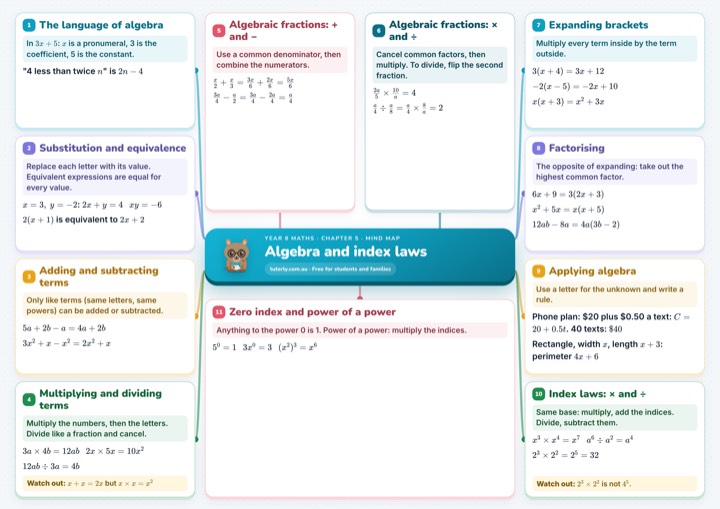
1The language of algebra
In : is a pronumeral, 3 is the coefficient, 5 is the constant.
"4 less than twice " is
2Substitution and equivalence
Replace each letter with its value. Equivalent expressions are equal for every value.
:
is equivalent to
3Adding and subtracting terms
Only like terms (same letters, same powers) can be added or subtracted.
4Multiplying and dividing terms
Multiply the numbers, then the letters. Divide like a fraction and cancel.
Watch out: but
5Algebraic fractions: + and −
Use a common denominator, then combine the numerators.
6Algebraic fractions: × and ÷
Cancel common factors, then multiply. To divide, flip the second fraction.
7Expanding brackets
Multiply every term inside by the term outside.
8Factorising
The opposite of expanding: take out the highest common factor.
9Applying algebra
Use a letter for the unknown and write a rule.
Phone plan: $20 plus $0.50 a text: . 40 texts:
Rectangle, width , length : perimeter
10Index laws: × and ÷
Same base: multiply, add the indices. Divide, subtract them.
Watch out: is not .
11Zero index and power of a power
Anything to the power 0 is 1. Power of a power: multiply the indices.

Year 8 maths · Chapter 5 · Mind map
Algebra and index laws
tuterly.com.au · Free for students and families
See the full mind map
Free with your email, plus the A4 PDF to print.
In this chapter
- 5A The language of algebra
- 5B Substitution and equivalence
- 5C Adding and subtracting terms
- 5D Multiplying and dividing terms
- 5E Algebraic fractions: + and −
- 5F Algebraic fractions: × and ÷
- 5G Expanding brackets
- 5H Factorising
- 5I Applying algebra
- 5J Index laws: × and ÷
- 5K Zero index and power of a power
Practise it
Free worksheets with worked solutions: