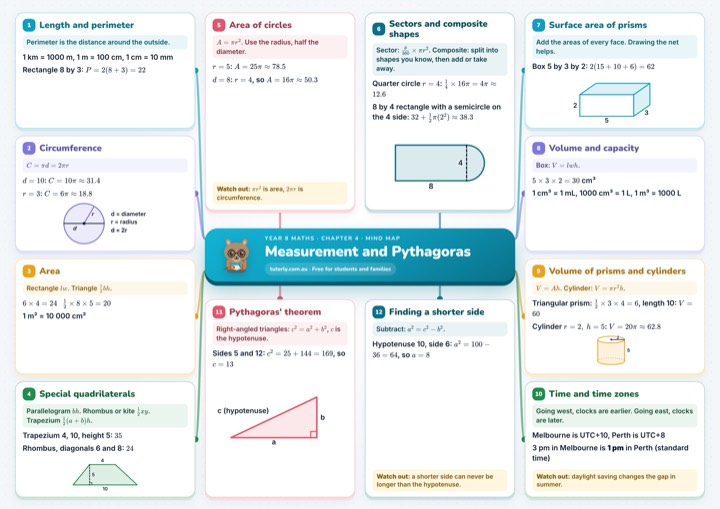
1Length and perimeter
Perimeter is the distance around the outside.
1 km = 1000 m, 1 m = 100 cm, 1 cm = 10 mm
Rectangle 8 by 3:
2Circumference
:
:
3Area
Rectangle . Triangle .
1 m² = 10 000 cm²
4Special quadrilaterals
Parallelogram . Rhombus or kite . Trapezium .
Trapezium 4, 10, height 5:
Rhombus, diagonals 6 and 8:
5Area of circles
. Use the radius, half the diameter.
:
: , so
Watch out: is area, is circumference.
6Sectors and composite shapes
Sector: . Composite: split into shapes you know, then add or take away.
Quarter circle :
8 by 4 rectangle with a semicircle on the 4 side:
7Surface area of prisms
Add the areas of every face. Drawing the net helps.
Box 5 by 3 by 2:
8Volume and capacity
Box: .
cm³
1 cm³ = 1 mL, 1000 cm³ = 1 L, 1 m³ = 1000 L
9Volume of prisms and cylinders
. Cylinder: .
Triangular prism: , length 10:
Cylinder :
10Time and time zones
Going west, clocks are earlier. Going east, clocks are later.
Melbourne is UTC+10, Perth is UTC+8
3 pm in Melbourne is 1 pm in Perth (standard time)
Watch out: daylight saving changes the gap in summer.
11Pythagoras' theorem
Right-angled triangles: , is the hypotenuse.
Sides 5 and 12: , so
12Finding a shorter side
Subtract: .
Hypotenuse 10, side 6: , so
Watch out: a shorter side can never be longer than the hypotenuse.

Year 8 maths · Chapter 4 · Mind map
Measurement and Pythagoras
tuterly.com.au · Free for students and families
See the full mind map
Free with your email, plus the A4 PDF to print.
In this chapter
- 4A Length and perimeter
- 4B Circumference
- 4C Area
- 4D Special quadrilaterals
- 4E Area of circles
- 4F Sectors and composite shapes
- 4G Surface area of prisms
- 4H Volume and capacity
- 4I Volume of prisms and cylinders
- 4J Time and time zones
- 4K, 4L Pythagoras' theorem
- 4M Finding a shorter side
Practise it
Free worksheets with worked solutions: