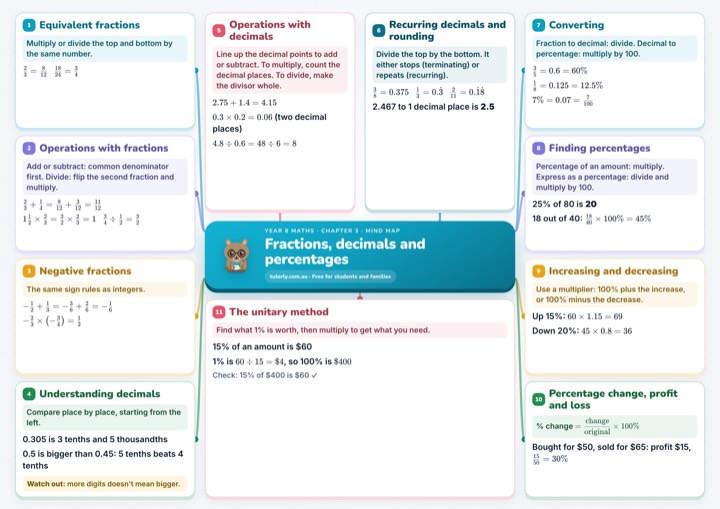
1Equivalent fractions
Multiply or divide the top and bottom by the same number.
2Operations with fractions
Add or subtract: common denominator first. Divide: flip the second fraction and multiply.
3Negative fractions
The same sign rules as integers.
4Understanding decimals
Compare place by place, starting from the left.
0.305 is 3 tenths and 5 thousandths
0.5 is bigger than 0.45: 5 tenths beats 4 tenths
Watch out: more digits doesn't mean bigger.
5Operations with decimals
Line up the decimal points to add or subtract. To multiply, count the decimal places. To divide, make the divisor whole.
(two decimal places)
6Recurring decimals and rounding
Divide the top by the bottom. It either stops (terminating) or repeats (recurring).
2.467 to 1 decimal place is 2.5
7Converting
Fraction to decimal: divide. Decimal to percentage: multiply by 100.
8Finding percentages
Percentage of an amount: multiply. Express as a percentage: divide and multiply by 100.
25% of 80 is 20
18 out of 40:
9Increasing and decreasing
Use a multiplier: 100% plus the increase, or 100% minus the decrease.
Up 15%:
Down 20%:
10Percentage change, profit and loss
% change
Bought for $50, sold for $65: profit $15,
11The unitary method
Find what 1% is worth, then multiply to get what you need.
15% of an amount is $60
1% is , so 100% is
Check: 15% of $400 is $60 ✓

Year 8 maths · Chapter 3 · Mind map
Fractions, decimals and percentages
tuterly.com.au · Free for students and families
See the full mind map
Free with your email, plus the A4 PDF to print.
In this chapter
- 3A Equivalent fractions
- 3B Operations with fractions
- 3C Negative fractions
- 3D Understanding decimals
- 3E Operations with decimals
- 3F Recurring decimals and rounding
- 3G Converting
- 3H Finding percentages
- 3I Increasing and decreasing
- 3J Percentage change, profit and loss
- 3K The unitary method
Practise it
Free worksheets with worked solutions: